Mona's transformation
Blood CanticleMona’s transformation is the turning point at Blackwood Manor when Lestat de Lioncourt changes the gravely ill Mona Mayfair into a vampire. It reverses her immediate physical decline but leaves Lestat questioning whether her assent was truly informed or free: he gives her an escape from pain, yet understands that he has also bound her to an immortal existence she could not fully comprehend.
Background and decision
Mona’s illness has kept her in the hospital for two years. By the time she reaches Blackwood Manor, Lestat sees her as having endured years of treatment, pain, disrupted sleep, fever, and the loss of ordinary concentration. Her recent childbirth has also left her with a further ordeal: the child she bore has been taken from her. Against that history, the promise of becoming whole and breathing without pain, even for one hour, carries a force that complicates the idea of an ordinary choice.
Lestat frames vampirism as a permanent passage out of human life: the transformed person will be undead, immortal, and a killer outside mortal life. He also knows from an earlier transformation, that of his mother on the Ile St.-Louis, that the Dark Blood can restore a body diminished by age and consumption. He had once performed that transformation without knowing its name, compelled by love and fear; now that remembered precedent informs his offer to Mona.
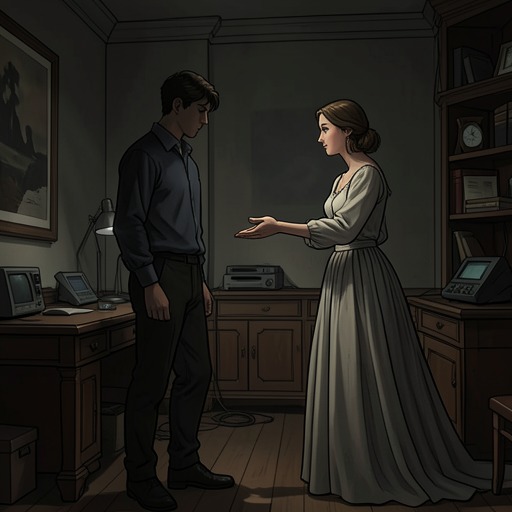
Lestat immediately offers to perform the Dark Trick, calling Mona his Little Witch and Quinn Blackwood his Little Brother. He tells Mona that she has a choice and raises the possibility of choosing the Light on another night. But Quinn has seen the Light, while Mona has not been given the same knowledge. Lestat recognizes the mismatch between the promise of recovery and the cost of the change, yet cannot resolve it by simply presenting the options: Mona has suffered too long, and her immediate wish is to be free of pain.
Mona reaches for Lestat and says yes. Quinn’s plea is to save her. The approaching Mayfairs intensify the urgency: Lestat can hear an ambulance and a limousine coming up the pecan-tree drive. The decision is made before they arrive, while Mona’s need for relief and the prospect of her family’s intervention press against Lestat’s awareness that this is an irreversible act.
The transformation
Lestat tells Quinn to let Mona go and explains that he must give her some of his blood first. Mona accepts it, and Lestat begins the change. The scene turns on a sharp reversal: within the transition, the pain that has defined her condition disappears. Lestat sees her enter a twilight state between human and vampire, her strength and appearance recovering as the Blood takes effect.
The transformation is not only something done to Mona; it also affects Lestat. As she draws his blood, he feels himself weakened and dizzy, then withdraws and clings to the bedpost. His memories surge as he gives her his blood, linking this new act to the experiences that made him what he is. The exchange makes the transformation a passage between them as well as a change in her condition.
Mona’s first clear response is to the absence of pain. She looks at Lestat with glazed eyes, apparently unable to believe that the suffering has stopped. After the transformation, she stands beside Quinn and looks down at Lestat among the flowers. He sees her as fulfilled, with the fever gone and the Blood’s power throughout her, and as the fledgling he had imagined. Quinn is present at her side, stunned and in love; Lestat imagines that the three of them will remain together for a long time.
Consent and consequence
The relief does not settle the moral question. Lestat knows that Mona still has no real grasp of what has been done to her. Although she assented, he concludes that she had not been able to give meaningful consent. His own stark interpretation is that he has murdered her soul: by making her a vampire, he has bound her to the Earth as the vampires are bound.
That judgment changes the meaning of the apparent rescue. The transformation has reversed the immediate bodily damage and freed Mona from pain, but it has also made her existence dependent on a state she could not fully understand at the moment she agreed. Lestat expects that when she wakes to what she has become, she may go out of her mind. He recalls Merrick Mayfair in thinking that those who reach for vampirism can go mad sooner than those who are transformed without choosing it. His fear is therefore not simply that the change will fail, but that its consequences will become clear only after Mona has entered it.
Continuing obligations
Lestat does not treat the transformation as a completed rescue. He believes he must see to it that Mona becomes the vampire he had envisioned, an obligation that follows directly from his recognition that he has made her immortal without her fully understanding the choice. When the approaching family becomes audible, Mona herself detects their arrival and is alarmed; as a new vampire, her emotions are heightened.
Her recovery also does not erase the unresolved circumstances of her childbirth. Later, Rowan Mayfair explains that Taltos milk can have curative properties for humans, while recalling a scene involving Rowan, a young female, and the buried body of that female. This information places Mona’s transformation within a wider conflict over illness, care, and the potential uses of Taltos bodies, though it does not undo or resolve Lestat’s decision.
The episode therefore holds two outcomes together without making either cancel the other. Mona’s pain ends and her strength returns; her assent is real, but Lestat believes it was not sufficiently informed to count as free consent. The transformation gives him what he sought for her in the immediate crisis while leaving him responsible for the permanent condition he imposed.